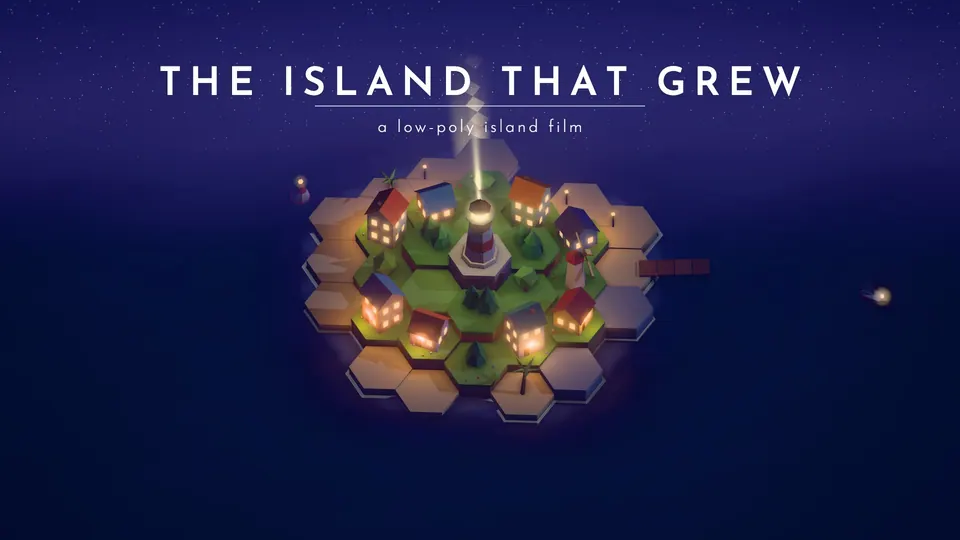
Video style · Low-poly isometric island
Low poly animation videos built tile by tile.
A low poly animation shows a small world made of flat-shaded geometric blocks: hexagonal tiles, box houses with prism roofs, cone trees, a faceted sea. Seen through an orthographic isometric camera, with light rather than texture telling the time of day, it suits growth stories, world building and calm content, where every piece that arrives lands with a bounce and a note.
- Example
- The Island That Grew, 0:53
- Drawn with
- Code, no footage
- Works on
Last updated
The example, moment by moment
What happens in The Island That Grew
An empty sea with a buoy that knows one note. Tiles, trees and houses rise one by one, each landing with a note, so the island and its song are written together, until at night a boat cannot find its way home and the last piece is a lighthouse.
-
An empty faceted sea with a single buoy that knows one note. The world has not started yet.
-
Tiles rise from the sea one by one, each landing with a bounce and a note, so the island and its melody are written together.
-
Trees pop, houses stack and a harbour forms while the camera turns slowly around the growing island.
-
A day passes as a time-lapse of light: every facet changes colour as the sun moves, and the horizon warms toward dusk.
-
Night. Windows glow as the only bright things, and a boat that went out cannot find its way home across the dark water.
-
The final piece lands: a lighthouse. Its beam turns, passes each house in order and replays the island's notes as the finished theme, before a pull-back to scale.
What the low-poly isometric island look is made of
- 01
Flat-shaded low-poly geometry
Hexagonal tile columns, box buildings with prism roofs, cone and icosahedron trees, a faceted sea. No rounded shading and no textures.
- 02
An orthographic isometric camera
No perspective and no horizon. Distance dissolves into a screen-space sky gradient, so the world looks like a model suspended in colour.
- 03
Light tells time
The sun's colour, height and direction are keyframed. Every facet re-colours as the day passes, and at night only emissive blocks keep their colour.
- 04
Pastel, few hues
One ground family, one neutral rock and a small set of wall and roof colours repeated across buildings. Shadows and ambient occlusion are the only darks.
- 05
Arrival with a bounce and a note
Every piece lands with a springy overshoot and plays a note, so building the world and composing its music are the same act.
- 06
Scale by pure zoom
The orthographic camera can push from a whole world to one tile, or pull back until the island is a speck, without any change of perspective.
Best for
- Growth stories: a startup's first year, a community, a reef recovering
- World building for games, places and campuses
- Calm and ambient content
- Real-estate and masterplan previews told as time
- Product ecosystems assembled piece by piece
Not for
- Close-ups of real products or faces
- Fast, dense information
- Dark or gritty subjects
- Photographic realism
Scene outline
How to make a low poly animation in this style
Fill-in scripts: data story video , mini story video , timeline video
- 1 0–6 s
Emptiness
Start with almost nothing: a sea, a void, one object that knows one note.
- 2 6–20 s
First pieces
Tiles, trees and buildings arrive one by one, each with a bounce and a note, while the camera turns around the growing world.
- 3 20–32 s
A lived-in day
Let light move from morning to dusk as a time-lapse, with small life such as boats and carts following paths.
- 4 32–44 s
Night and the problem
Desaturate toward blue-violet, light the windows, and introduce the one thing that is missing.
- 5 44–50 s
The final piece
The piece that solves it lands and ignites: a lighthouse, a bridge, a server, a school.
- 6 50–55 s
Scale
Pull back until the world is small, with an echo of the opening sound.
When growth is the story
Some messages are about accumulation: a company that went from two people to two hundred, a neighbourhood that filled in, a product that gained a feature a month, a reef that came back. A low-poly world tells that story without a chart. Pieces arrive, the island gets bigger, the day passes, and by the end the viewer has watched something become a place. The orthographic camera makes it feel like a model on a table, which is calming in a way most motion graphics are not.
The style also suits previews of things that do not exist yet. A masterplan, a campus, a festival site or a game world can be built in front of the viewer, and a final pull-back puts it in scale.
It is a poor fit for detail. A low-poly phone is a box, a low-poly face is a mistake, and dense information gets lost between the facets. If your message is numbers and steps, an isometric infographic does the same geometry with labels.
Writing for a world that builds itself
Start from emptiness and one sound. The first piece should arrive alone and be heard, because the style’s promise is that building is composing. Then plan the order of arrival as a melody: tiles first, then trees, then houses, with arrivals on quarter notes, then eighths, then waves, so the viewer feels the world speeding up.
Give the world a day. Light is the clock in this style: facets re-colour as the sun moves, the horizon warms at dusk, and night desaturates everything toward blue-violet except the windows. A day is a story on its own, and night is where the problem lives.
Plan the final piece. The best low-poly stories end on one object that solves the night: a lighthouse for a lost boat, a bridge between two halves, a server that lights a network. Let it ignite, and let its light replay the notes of everything built before it.
Palette and brand
Keep it pastel and low-contrast with a handful of hues: one ground family, one neutral rock and a few wall and roof colours repeated across buildings. A brand colour works as the roof colour or as the one emissive hue at night. No outlines and no black; shadows are the only darks.
How OpusCar fits
OpusCar renders scenes from code, which is how every arrival can be timed to a note and every facet re-coloured by the sun without hand animation. Bring the world, what grows in it and the one thing that is missing at night. The script, voiceover, animation, captions and posting schedule follow in one flow.
Where a low poly animation earns its place
Low-poly world FAQ
What is low poly animation?
Low poly animation is 3D animation that uses models with few polygons and flat shading, so every surface reads as a clean facet rather than a smooth or textured form. It is light to render, easy to keep consistent from shot to shot, and has a toy-like calm that suits world building and growth stories.
Why an isometric camera?
An orthographic isometric camera has no perspective, so near and far objects stay the same size and the world reads as a model on a table. The camera can turn, zoom and follow without breaking that illusion, and a pull-back to scale, from one tile to a whole island, is pure zoom.
Can the music really come from the building?
Yes. In the example every growth event is exported with a note and the melody is synthesised from those events, then replayed in spatial order by the lighthouse beam. The same idea works at any scale: a skyline whose floors are notes, a garden whose flowers form a chord, a team assembling a product.
What length and format work best?
45 to 60 seconds for a growth story with a day, a night and a final piece. Square and vertical crops work because the world sits in the centre of the frame, and a 15-second cut of the build sequence makes a satisfying loop.
More video styles
All 11 styles-
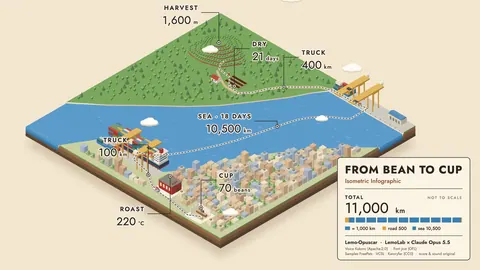 0:59 Isometric infographic
Process explainer
From Bean to Cup: One coffee bean travels from a hillside farm to a cup in a single isometric take: every step is a station on one board, the route is a dashed line, and every number is built from icons. See the process explainer video -
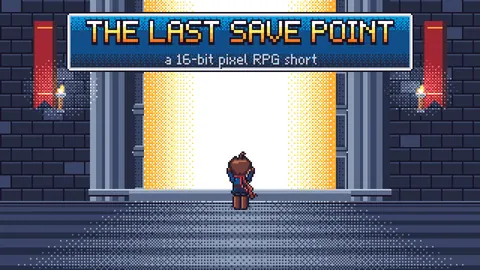 0:55 16-bit pixel RPG
Pixel art recap
The Last Save Point: At the final boss door, a hero saves the game, and the save screen replays the whole journey: memories drawn in fewer colours, a name greyed out in the party list, and full colour flooding back before the last slot is written. See the pixel art video -
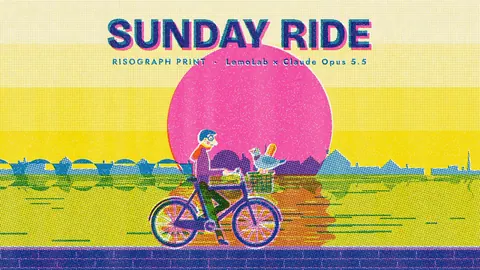 0:40 Risograph print
Risograph brand story
Sunday Ride: A lanky rider in round glasses cycles across town on a Sunday morning to eat breakfast by the river. The city starts in one ink, and each stop adds a plate until all three overprint and the film turns out to be one sheet sliding out of the printer. See the risograph animation
Sign up
Make your first ten videos this week.
Sign up with your email and we’ll get you set up with OpusCar.
We’ll only email you about your account. No spam.